01
Planet 2048-d
Federated aggregation over open Earth foundation models — Aurora, Prithvi-WxC, GraphCast, GenCast.
Global summary
Earth already has eyes on it — Copernicus, Earth Engine, Aurora, GraphCast. What it doesn’t have is the wire between those eyes and a network that can actually respond. PLANETAI is an instrument for closing that loop: community-scale sensing, bioregional decision, distributed fabrication response — in days-to-months, not years-to-decades.
Trace the build-up to PLANETAI → 12 years, 16 projects, 4 phases
The gap
A satellite pass tells a European ministry that PM2.5 in a valley crossed a threshold in March. The ministry feeds it into a policy cycle that reports in 2028, legislates in 2030, permits retrofits in 2032, and measures impact in 2035.
The observation was excellent. The response took a decade. During that decade the valley kept breathing the same air.
Existing Earth observation is calibrated to intergovernmental treaties. PLANETAI is built for the opposite loop.
PLANETAI’s nodes are also a way to protect distributed public capacity for observation, science, citizenship and policy when the centralised version is fragile.
The instrument
Each tier is simultaneously a computational layer, a governance layer, a data layer, and a fabrication-and-deployment layer. Dimensionality descends from planetary foundation models to on-device inference. Why these five? One test: each is a stratum where an observation can reach a decision body the network can put a proposal in front of, and the approved response can be fabricated inside the network — where the loop closes, and can be timed.
Federated aggregation over open Earth foundation models — Aurora, Prithvi-WxC, GraphCast, GenCast.
Watershed / ecoregion. Partner-hosted servers, knowledge graphs, OSH/OKH response-template library, community-council veto.
Multi-city / state / province. Where governance and supply-chain coordination actually live — Generalitat-class open-data publishers, regional GHG inventories, inter-city procurement.
Municipal dashboards, Metroverse ECI, Amsterdam Circular Monitor template, Boeing Fab City Index.
Neighborhood · fab-lab shed · campaign sensor archive. Compact federated-data node at the fab lab, local sensor integration, fabrication queue, action-cycle timestamps. PKC framework as the individual antecedent extended upward.
The node
The observatory you see is the cloud face of a deployable node — a small open-hardware box that lives at a fab lab and ingests planetary models, bioregional data, and its own community’s sensor feed. One node per pilot; the first has been running in Bali since September 2026. On each node, a narrow set of action agents drafts measured responses into a queue — a named human approves or rejects before anything fires.
Live · node #1 · since 2 September 2026
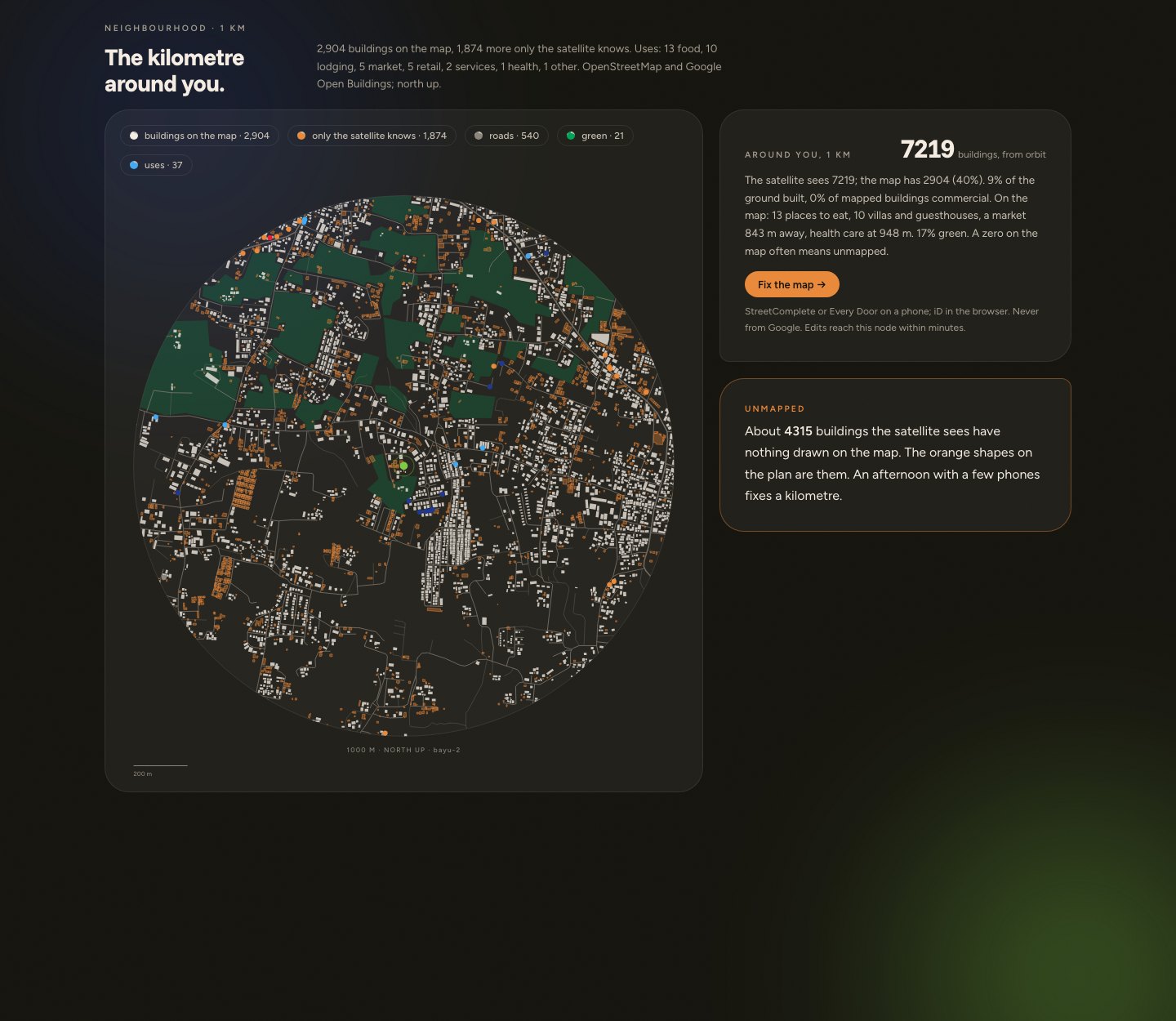
Node #1 sits in Kuta Selatan reading four sensors that were already in the house, the island’s public network, a radio gateway for sensors with no WiFi, and overhead the Copernicus atmosphere model, the ocean model, Earth Engine’s view of the land and Google’s open building footprints. It decides where it stands, tells the household what to do in plain sentences on Telegram, answers their questions through a small model on its own machine, and records whether anyone acted: ρ, the Index’s action-latency term, measured for the first time. In its first week: two of every three alerts led to someone doing something.
PLANETAI Node v0 · Open hardware
The node runs the Region, City, and Community tiers as a storage-rich, asynchronous compute layer. It retains local data, caches what the bioregion needs, and pairs upstream Earth-foundation embeddings with locally-curated observations. Federated by design — one node per pilot, four nodes ship.
What the node does. Federated data retention, raster and sensor cache, model checkpoints, Region / City / Community-tier feature extraction, periodic model updates. Aurora and GraphCast run upstream at bioregion-server scale; the node consumes their embeddings and pairs them with locally-curated data.
Action agents · Human-in-the-loop
Agents are constrained — each runs a single bioregion-specific workflow. They draft, they never dispatch. Every draft → approve → deploy cycle writes to a public audit ledger, timestamped against the action-latency hypothesis.
Two claims, on trial
H0−T · Throughput (null)
Null: distributed production at community and city tiers does not causally reduce urban material throughput or energy demand by more than 15% over 36 months, measured against a synthetic control baseline.
H0−A · Action-latency (null)
Null: coupling multimodal observation to the Fab Lab network does not measurably shorten observation-to-action cycle time, relative to a policy-only baseline anchored on three completed Fab City Challenge editions (Bali 2022, Bhutan 2023, Mexico 2024; 12–16 weeks brief-to-prototype), across 4 community hubs (one per pilot) using difference-in-differences estimators.
The network
~2,700
Fab Labs
Fablabs.io
56
Signatory
Fab Cities
15yr
Campaign archive,
Barcelona
3
Fab City Challenge
editions delivered
Apache 2.0
OpenRAIL
CC-BY 4.0
The instrument
is open
The leverage isn’t building a new network — the network exists. It’s the coupling that turns it into an instrument.
The monitoring case is in the literature: Balestrini, Diez et al. (EAI Trans. IoT, 2015) — a 15-month SmartCitizen deployment study across two communities — find local-champion orchestration is the determinant of sustained participatory sensing; Chen, González et al. (Atmospheric Pollution Research, 2025) show low-cost sensors deployed via fab-lab institutional support meet US EPA performance targets at R² > 0.7, RMSE < 5 µg/m³. The action case is also documented: Thomas (2023, ADB ex-ante BCA / Zenodo) projects $5–12 BCR for the 2023 Fab Bhutan Challenge through 2033.
Four bioregions
Each bioregion discloses what exists and what’s being built. We do not flatten them into identical templates; instrumentation reality differs, and saying so matters more than a clean card grid.
Mediterranean P0 · anchor Pledge 2014
Instrumentation: strongest in the network. Live municipal feeds via Sentilo, 2,800+ open datasets via OpenData.cat MCP, plus a 15-year Smart Citizen campaign archive (~25 kits actively reporting on a given day — the campaign archive between campaigns). Full Eurostat EW-MFA, direct Metroverse coverage.
Where the stack is proven before it is exported.
North Atlantic P1 FAB26 + Summit host 2026
Cold-climate heat-island dynamics. Community sensor fleet needs building; we name that honestly.
First test of federation across a statistically different bioregion.
Southern Cone P1 Pledge 2017
Andean / coastal / central-valley climatic bands. ~75% of urban employment is informal — ILO 21st ICLS (2023) is the Community-tier instrument.
Where formal-sector data alone produces a misleading picture.
Indonesian Archipelago P2 Pledge 2022
Tropical-humid, cyclone-exposed, archipelagic. Bali falls into the same PITO/DIDO/ρ taxonomy as every other pilot. Two sovereign sources feed the framework: Bali Satu Data (4,700+ provincial datasets organised through Tri Hita Karana cosmological categories) for City- and Region-tier throughput, and the WIPO Global Innovation Index 2025 (Indonesia 55/139) as the country-level Bioregion peer anchor.
Where sovereignty-by-architecture is stress-tested hardest.
What we’re honest about
The observatory tags every value with provenance — LIVE, CACHED, SYNTHETIC, PENDING. The research programme holds itself to the same standard.
Cross-network sensor normalisation is not solved. It is a research deliverable of this proposal, not a completed primitive.
Bali has no Metroverse City-tier ECI. We reconstruct the City-tier signal from Bali Satu Data (provincial open data, 4,700+ datasets, Tri Hita Karana taxonomy) feeding the same PITO/DIDO/ρ framework every other pilot uses — no Bali-specific index. Engineering ingests via data.go.id (CKAN 3.0 national portal) plus a Bali Satu Data scraper; partner collaboration with Diskominfos is year-one work.
Community sensors carry ±30–80% uncertainty against reference instruments (Castell et al. 2017); ≥30-day colocation is the required calibration protocol before any reading enters the bioregional index.
We have committed to publishing null results if either hypothesis fails to reject. The pre-registration is the instrument’s own peer review.
Enter
The Core Ideas Paper is the argument. The observatory is the first working prototype — partner-preview build, with live connectors already wired and synthetic placeholders clearly marked.
Apache 2.0 Fab City Foundation Core Ideas Paper April 2026